The Big Bang Theory
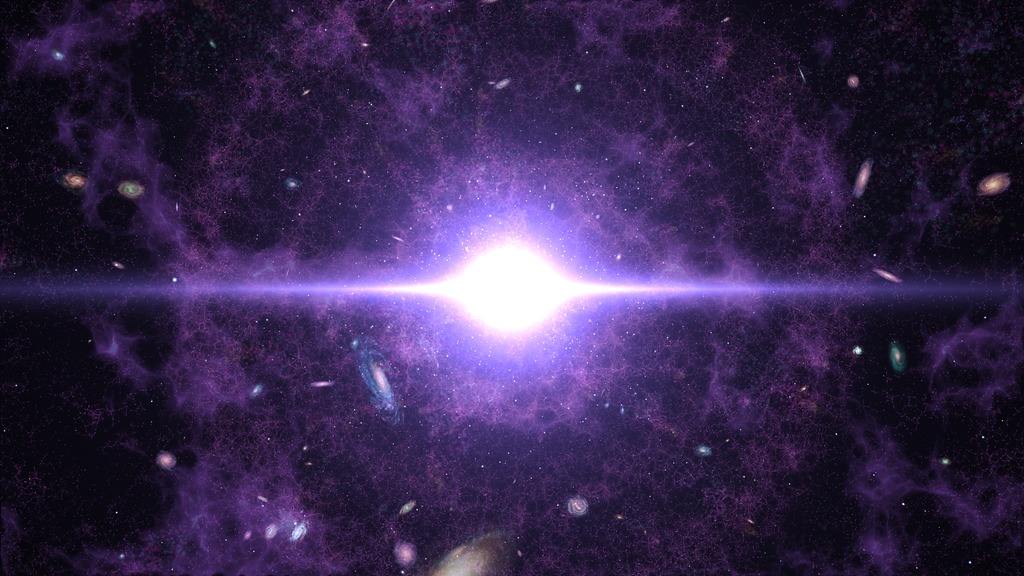
The Big Bang is the most accepted and popularized theory about the beginning of the Universe. Around 1920s an American astronomer, Edwin Hubble proved that galaxies were moving apart form each other at huge speeds which can be calculated by Hubble's Formula. The Doppler Red Shift of light observed from distant stars and galaxies gives further evidence that the universe is expanding. A Russian Mathematician, Alexander Friedmann had pointed out, if the Universe is expanding because galaxies are moving apart, then galaxies must have been much closer in the past than they are now and still closer a million years ago. Even earlier (approx. 13.8 billion yrs ago) all galaxies must have been a part of one great mass (the cosmic egg).
Before Big Bang there was nothing universe was just an empty void (there was no time, no space before the Big Bang). Some cosmic event triggered the cosmic egg to explode. Cosmic egg exploded flinging all it's matter out, approximately at the speed of light. Over time the matter condensed and form the first galaxies and the Universe.
The theory was popularized by Physicist, George Gamow. He named this Cosmic event "Big Bang", and this is how the The Big Bang Theory developed.
- How can something come from nothing?
- What were the conditions that led to the Big Bang?

Comments
Post a Comment